A single-use box may cost less to buy. But does that mean it is cheaper to use?
Not always.
If a reusable box costs more upfront but can complete 10, 20, or even more trips, its real cost may be much lower over time.
So the better question is not:
“Which box is cheaper?”
It is:
“How much does each trip actually cost?”
That is what we will compare here: purchase cost, cost per trip, break-even point, and how reusable transport packaging actually works in fresh produce, cold-chain, warehouse, and industrial applications.
What Is Reusable Transport Packaging?
Reusable transport packaging is designed to be used more than once during shipping, storage, or material handling.
Common examples include plastic boxes, totes, bins, pallets, and containers used between farms, factories, warehouses, distribution centers, and customers.
In closed-loop supply chains, reusable transport packaging is also commonly described as returnable transport packaging, because the containers are collected and returned for the next cycle.
For fresh produce, a typical route may be:
Farm → Cold Storage → Distribution Center → Supermarket or Wholesale Market → Collection → Farm
After unloading, the boxes are collected, cleaned, and used again.
Industrial supply chains work in a similar way. Packaging can circulate between a parts supplier, warehouse, production line, and assembly plant.
The basic idea is simple:
keep the packaging in the supply chain and reuse it whenever the logistics system allows it.
Reusable vs Single-Use Packaging
| Comparison | Reusable Transport Packaging | Single-Use Packaging |
|---|---|---|
| Initial cost | Higher | Lower |
| Uses | Multiple trips | Usually one trip |
| Cost over time | Falls with successful reuse | Repeats with every shipment |
| Water resistance | Usually better with plastic systems | Depends on material |
| Repeated handling | Designed for repeated use | Mainly for one-way use |
| Cleaning | Possible | Usually unnecessary |
| Return logistics | Often required | Usually not required |
| Waste | Lower over repeated cycles | New packaging needed each trip |
A single-use box may look cheaper on a quotation.
But the next shipment needs another box.
Reusable packaging costs more at the beginning, but that cost can be spread across many trips.
Cost per Trip and Break-Even Point
Purchase price alone does not show the real packaging cost.
The simplest way to compare the two systems is:
Cost per Trip = Packaging Cost ÷ Actual Number of Uses
The important word is actual.
A box may be designed for 30 cycles, but if it is lost or damaged after eight trips, its real cost per trip will be very different.
In real projects, reuse life depends on:
- Material formulation
- GSM and thickness
- Box structure
- Packed weight
- Stacking conditions
- Transport route
- Handling
- Cleaning and storage
For many of our fresh produce projects, customers ask us to design boxes for approximately 20–50 reuse cycles under normal handling conditions.
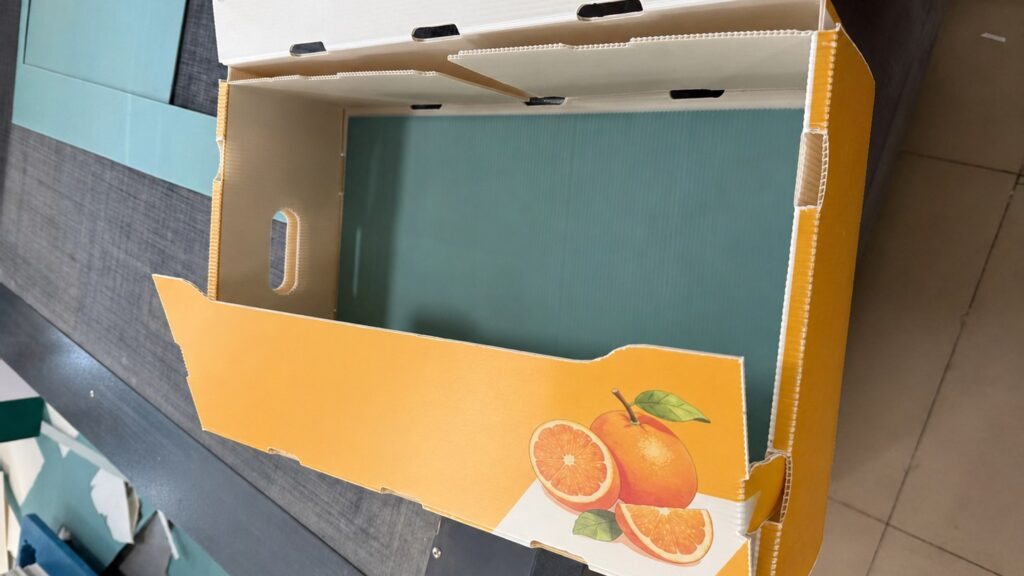
A common corrugated PP produce box sells for around $5–7 and carries approximately 10–15 kg of produce.
A single-use corrugated paper produce box may cost around $1–2.
The basic break-even calculation is:
| Reusable PP Box | Single-Use Paper Box | Approx. Break-Even |
|---|---|---|
| $5 | $2 | About 3 trips |
| $5 | $1 | 5 trips |
| $7 | $2 | About 4 trips |
| $7 | $1 | 7 trips |
So based on packaging purchase cost alone, the reusable PP box can reach its basic break-even point after approximately 3–7 trips.
Take a simple middle example:
$6 reusable PP box ÷ $1.50 paper box = 4 trips
After four uses, the packaging purchase cost is roughly equal.
If the same reusable box continues to work:
- 4 trips: Paper boxes $6 / PP box $6
- 10 trips: Paper boxes $15 / PP box $6
- 20 trips: Paper boxes $30 / PP box $6
- 50 trips: Paper boxes $75 / PP box $6
Of course, real operating costs can also include:
return transport + cleaning + storage + handling + damage + loss
But the basic logic is clear.
If a box reaches its packaging-cost break-even point after 3–7 trips and can continue to work for 20–50 cycles, the value comes from spreading one purchase across many completed trips.
Where Reusable Packaging Makes Sense
Fresh Produce and Cold Chain
Fresh produce is one of the most natural applications.
A box may move through:
Farm → Cold Storage → Distribution Center → Supermarket → Collection → Farm
During this process, it may need to handle moisture, cold temperatures, stacking, repeated loading, and several logistics stages.
If empty boxes can be collected and returned in batches, the same packaging can continue into the next harvest or shipment.
Large retail supply chains such as Walmart and Sam’s Club also use reusable plastic packaging systems.
This type of packaging works well in supermarkets because it can handle several jobs at the same time:
transport, stacking, water resistance, storage, handling, retail movement, collection, cleaning, and reuse.
For this type of application, fresh produce packaging needs to be designed around the complete route, not just the first trip.
Long-Distance Shipping
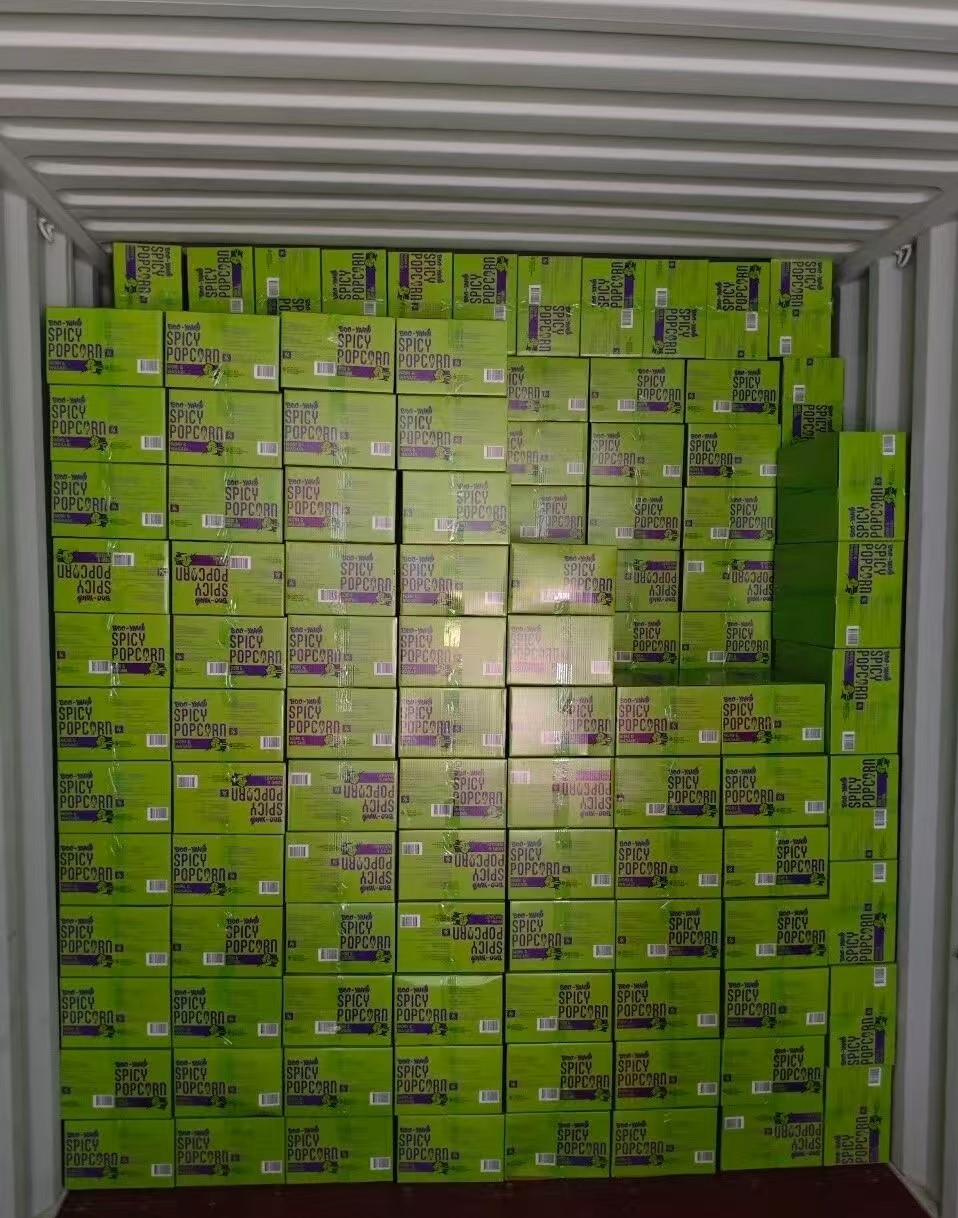
Long-distance transport does not automatically mean single-use packaging is better.
An export shipment may go through:
Factory → Truck → Port → Container → Destination Port → Warehouse → Market or Store
The packaging may face long stacking periods, moisture, repeated handling, warehouse transfers, and final retail handling.
Corrugated PP is waterproof by nature and can be structurally designed for higher stacking loads.
Even if the box does not return to the original factory, it can still reduce:
- Repacking
- Damaged outer cartons
- Moisture-related failure
- Extra handling
- Product damage
So the question should not simply be:
“Is this a long-distance shipment?”
It should be:
“How much protection does the product need through the whole journey?”
When Single-Use Packaging Still Makes Sense
Reusable packaging is not always the better choice.
If the route is short, dry, lightly handled, and the product needs little protection, a simple single-use box may be the more practical option.
Single-use packaging can also make sense when:
- Shipments are infrequent
- The packaging has no value after delivery
- There is no realistic return or reuse system
- The product is lightweight and not sensitive to moisture or stacking
- The packaging budget is extremely limited
- Handling is simple and controlled
The important point is that distance alone should not decide the packaging type.
A long-distance shipment may still benefit from stronger corrugated PP packaging, while a short and simple local shipment may work perfectly well with a disposable carton.
The decision should be based on the full journey, the protection requirement, and the real cost per trip.
Factory Storage and Internal Handling
Reusable packaging does not always need to leave the factory.
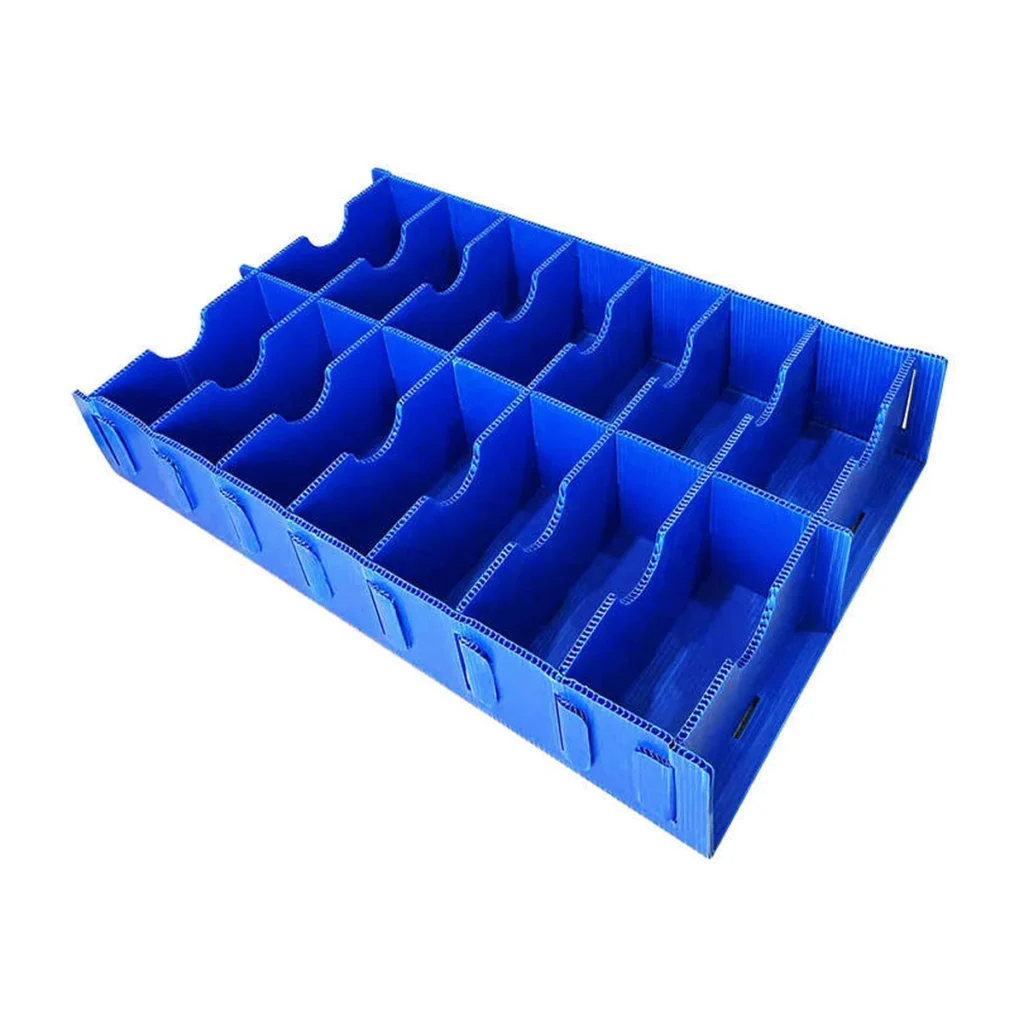
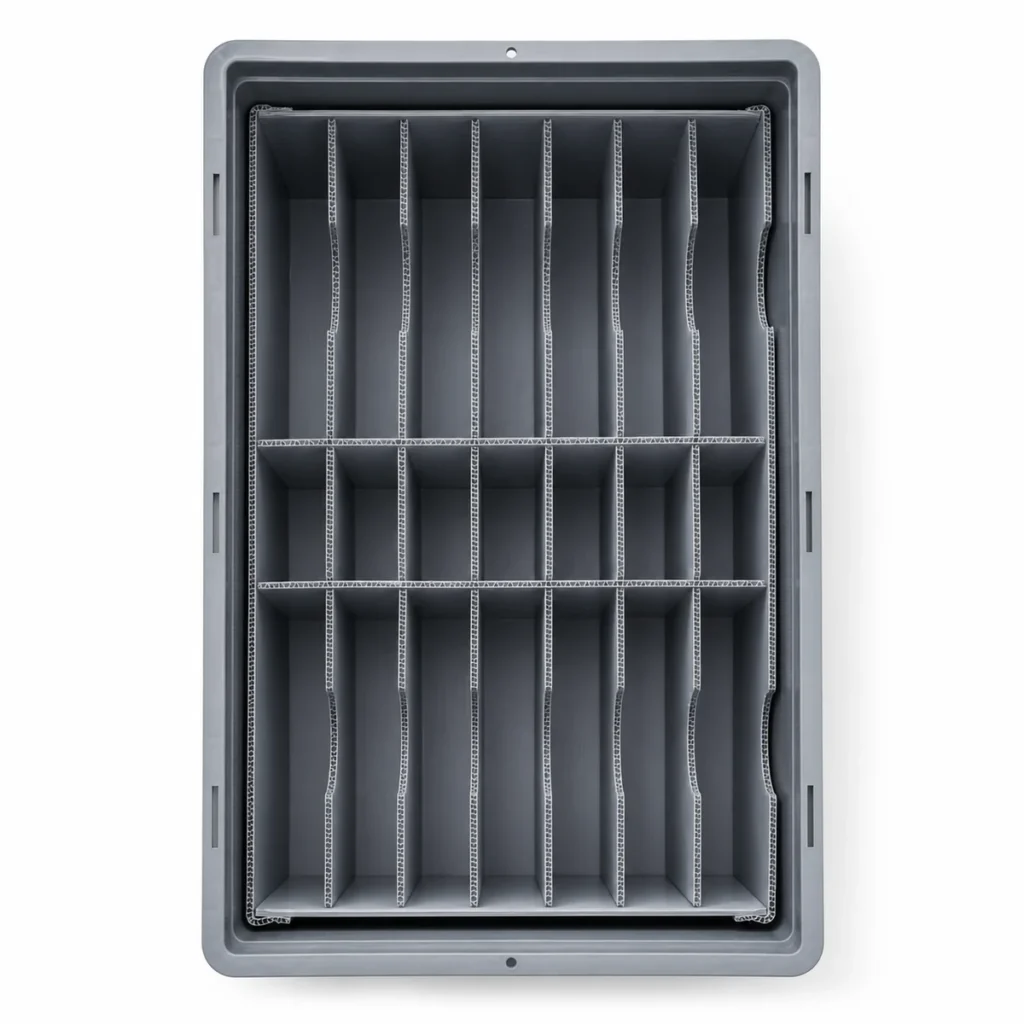
In a cool, ventilated warehouse with stable temperatures and enough storage space, corrugated plastic bins and totes can be combined with custom inserts for products such as:
- Fasteners
- Screws
- Electronic components
- Chips
- Automotive lamps
- Tools
- Hardware
- Small industrial parts
The inserts can be divided into sections or individual cells.
This helps workers quickly find the parts they need while also reducing contact and movement between components.
The whole box can then move directly from storage to a workstation, production line, or assembly area.
After use, it can be collected, cleaned, and returned to storage.
The cycle becomes:
Storage → Picking → Internal Transport → Assembly → Cleaning → Storage Again
At this point, the box is no longer just packaging.
It becomes part of the factory’s storage and internal logistics system.
This is where reusable and returnable transport packaging for warehouse flow creates value beyond simple transportation.
Real Project: Automotive Parts Packaging
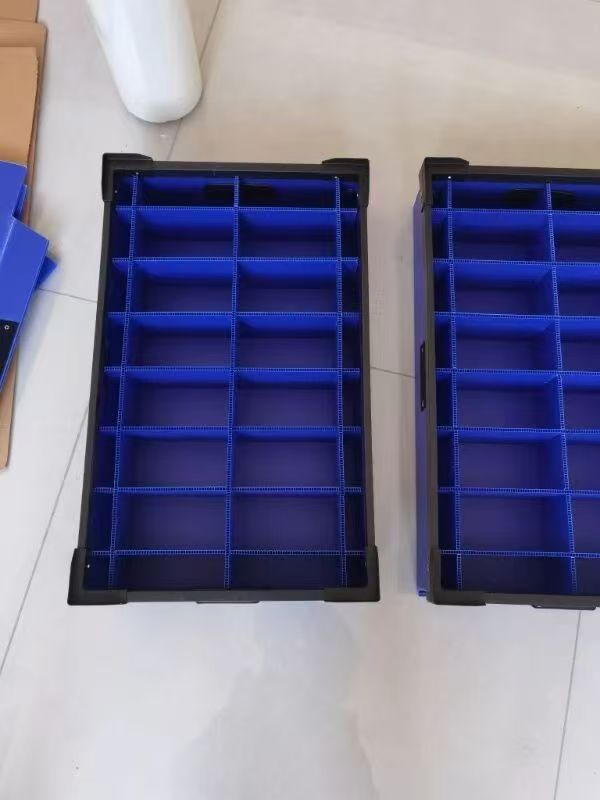
Recently, we developed a series of corrugated PP packaging designs for an overseas automotive factory customer.
The project included many sizes and structures because the packaging was used in different areas of the factory.
Some designs were for assembly workshops and production areas.
The products included:
- Chips and electronic components
- Automotive lamps
- Screws
- Fasteners
- Wrenches
- Hardware
- Other automotive components
For these applications, we designed:
Corrugated PP Outer Box + Custom Internal Inserts
The inserts give each component its own position inside the box.
This reduces direct contact, movement, friction, scratches, and handling damage.
Depending on the product, materials can also be designed with additional properties such as:
- Anti-static performance
- UV resistance
- Individual compartments
- Additional reinforcement
For chips and electronic components, anti-static performance may be important.
For automotive lamps, tools, and hardware, the main concern may be reducing collision and friction.
The complete box can move directly from the warehouse to the assembly workstation, without workers repeatedly transferring the parts into another container.
Other designs in the same project were developed mainly for warehouse storage.
Under stable, controlled warehouse temperatures, each part can have a defined storage position inside the PP box and insert system.
Workers can quickly see:
what the part is, where it belongs, and how many positions are available.
When production needs the parts, the complete box moves to the production area.
After use, the empty packaging is collected, cleaned, and returned for the next storage cycle.
The important point is that we do not simply choose a PP sheet first and then decide how to use it.
We start with the actual component and then design:
the outer box + custom dividers and inserts + compartment layout + material properties + load-bearing structure
around the real application.
This is also the design logic behind many industrial and automotive component packaging projects.
Why Corrugated PP Works for Reusable Packaging
Corrugated PP is based on polypropylene resin and may include mineral fillers such as calcium carbonate depending on the formulation.
Its water resistance comes from the plastic itself.
This is different from corrugated paper that relies on a laminated or coated surface for additional moisture protection.
If the coating is damaged, the paper underneath may still be affected by water.
PP corrugated sheet does not absorb moisture in the same way.
For fresh produce and cold-chain applications, ventilation or drainage holes can also be punched directly into the board.
This means the box can provide:
water resistance where protection is needed, and ventilation or drainage where the product needs it.
But material is only the starting point.
Engineers can also adjust:
- GSM
- Thickness
- Rib direction
- Ventilation and drainage
- Reinforced areas
- Box structure
- Handles
- Internal partitions
- Custom inserts
For example, a two-piece lid-and-base design allows both the upper and lower parts to contribute to load bearing.
Combined with the correct rib direction and reinforcement, this can improve edge compression and stacking strength.
For fresh produce, the focus may be:
ventilation + drainage + water resistance + stacking
For industrial components:
compression + separation + protection + identification + repeated handling
That is why two corrugated plastic boxes made from similar PP sheets can perform very differently.
Material provides the foundation. Structural design determines how it performs in the real application.
How to Choose the Right Packaging
Before choosing reusable or single-use packaging, ask a few practical questions:
- How often will the product be shipped or handled?
- Can the packaging stay inside the logistics system or factory?
- What product and weight does the box need to carry?
- Will it face moisture, cold storage, stacking, or repeated handling?
- How many cycles can it realistically complete?
- What is the true cost per trip after return, cleaning, handling, and losses?
There is no single packaging solution for every supply chain.
The best choice depends on how the product is actually transported, stored, handled, and reused.
Conclusion: Compare the Supply Chain, Not Just the Box Price
Reusable transport packaging and single-use packaging both have the right applications.
The important thing is not simply:
“How much does one box cost?”
It is:
“How many trips can it complete, how well does it protect the product, and what does it really cost across the entire supply chain?”
If packaging can be collected, cleaned, and used again, reusable or returnable transport packaging can significantly reduce the cost per trip.
If the route involves moisture, stacking, cold storage, repeated handling, factory storage, or a demanding logistics chain, corrugated PP packaging can also reduce repacking and product damage.
A good packaging solution is not simply a stronger box.
It should be designed around the actual:
product + load + transport route + storage conditions + handling process + reuse target.
That is where reusable transport packaging creates real value.